
5G is often described in terms of speed and low latency, but for device manufacturers, the challenge lies in translating these capabilities into real world performance. Behind every reliable 5G connection is a carefully designed RF front end and at the heart of it sits the antenna.
While mmWave 5G attracts attention, most real-world 5G deployments today rely on Sub-6 GHz frequencies, especially in embedded and industrial devices. This is where compact, surface-mount (SMD) antennas play a critical role.
This article explores why Sub-6 GHz 5G matters, where it’s used, the key antenna insights and the “aha!” moments that determine real-world performance.
What is 5G?
At its core, 5G is:
- Higher data throughput
- Lower latency
- Supporting more connected devices
5G operates across two main frequency ranges:
- Sub-6 GHz - offering wide coverage, good penetration, and reliable performance
- mmWave - offering extremely high data rates, but only over short distances
While mmWave is impressive, Sub-6 GHz is the foundation of today’s practical 5G devices, especially for embedded electronics, routers, gateways, and industrial equipment.
Why most 5G devices rely on sub-6GHz Frequencies
Sub-6 GHz frequencies provide a balance that embedded systems require:
- Longer communication range
- Better signal penetration through enclosures and obstacles
- Lower power consumption
Common Sub-6 GHz 5G bands include:
- 617-698 MHz (US)
- 3300-4200 MHz (Europe)
- 4400-5000 MHz (Asia)
- 5925-7125 MHz (US)
For device designers, this means antennas must often support multiple wide frequency bands in a very limited PCB area, a challenge that places antenna design at the center of system performance.
Where 5G is actually used today
Beyond smartphones, Sub-6 GHz 5G is already enabling a wide range of applications:
- Industrial IoT gateways
- Smart meters and utilities
- Asset and fleet tracking
- Smart city infrastructure
These applications share common requirements such as compact size, reliability and performance often in electrically noisy or space constrained environments.
The “Aha!” Factor: Antennas Define 5G Performance
Two devices using the same 5G modem can perform very differently because of the antenna.
As frequencies increase and bandwidths widen, antennas become more sensitive to:
- PCB/Ground plane size and layout
- Nearby components (batteries, displays, shields)
- Device enclosures and materials
A high-performance modem cannot compensate for a poorly integrated antenna. In many cases, the antenna becomes the limiting factor in data rate, link stability, and certification success.
This is why antenna selection and placement must be considered early in the design cycle, not as an afterthought.
Why SMD Antennas Are Well-Suited for Sub-6 GHz 5G
Surface mount antennas offer several advantages for modern 5G devices:
-
Compact, space efficient form factors
-
Automated pick-and-place assembly
-
Repeatable RF performance across production runs
Wideband SMD antennas can be paired with simple matching networks, allowing the antenna to be fine-tuned to their specific PCB and enclosure an approach that balances flexibility with development speed.
Design Considerations That Matter
Successful 5G antenna integration depends on more than just selecting a part number. Key factors include:
-
Ground clearance and keep-out areas
-
Antenna placement relative to board edges
-
Matching network
-
Distance from metal, batteries, and displays
-
Testing in the final mechanical enclosure
Designers who address these factors early can significantly reduce development risk and improve first-pass certification success.
Antenova Opaca:
A practical example of a Sub 6GHz 5G ready SMD antenna is the Opaca from Antenova.
Opaca (SR4L104) is designed to support wideband cellular operation, making it suitable for modern devices that must operate across LTE and emerging 5G sub 6GHz including lower band frequencies band n71(617 – 698 MHz) as well as mid-band 5G frequencies n77 (3300 – 4200MHz) and n78 (3300 – 3800MHz) for European deployments. The antenna’s extended upper frequency support includes n96 (5925-7125MHz) making it suitable for globally targeted devices.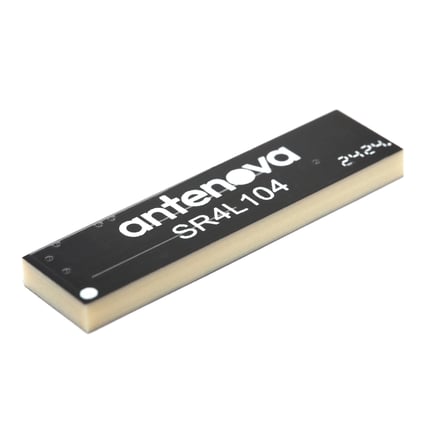
Key Features:
-
Antenna for 3G, 4G and 5G bands applications
-
High performance: DFI (Designed for Integration)
-
Suitable for high volume manufacturing
-
High Efficiency (helps with gaining PTCRB certification)
While processors and modems often dominate the design discussion, antennas determine whether a 5G device succeeds or fails in the field.
For Sub-6GHz applications, SMD antennas such as Antenova’s Opaca provide practical, scalable route to reliable 5G connectivity and enable the performance that modern connected devices require.
Thank you for reading our article. Antenova offers a host of support materials to add to your knowledge base.
Follow the links:
Opaca – SR4L104 Product Detail Page where you will find datasheet, footprint, and 3D model. In addition, you can request a sample and a quote, check distributor availability, and try out the Antenna Placement Tool.
Contact the sales team in your area:
Antenova AMERICAS - americasales@antenova.com
Antenova EMEA – emeasales@antenova.com
Antenova ASIA – asiasales@antenova.com
ask.antenova Join our global antennas & wireless design community. This is an opportunity to communicate directly with our top engineers as well as community members.