5G offers significantly faster speeds (5G’s gigabits vs. 4G's megabits), much lower latency (1ms vs. 30-50ms), and greater capacity than 4G LTE.
We will examine how video surveillance has improved with 5G. Surveillance cameras on 4G have limited video resolution due to the capacity limitations of the 4G network. Moving from 4G to 5G requires a cellular design with new higher bandwidth antennas to cover the additional 5G bands.
High-resolution cameras
5G cellular connectivity enables higher resolution video such as high-definition (HD) and ultra-high definition (UHD). Higher resolution images enable more evidence to be collected from criminal activity and enable city authorities to identify faces from video feeds, which contributes towards a reduction in crime.
The large-scale deployment of 5G enables a network of high-resolution cameras to be installed throughout cities. 5G cameras offer flexibility for remote and hard-to-reach locations when compared to cabling or local Wi-Fi infrastructure. The limitation of 4G (insufficient bandwidth for multiple HD streams) is overcome by the large capacity of 5G, enabling thousands of cameras to transmit 4K and 8K video simultaneously.
.jpg?width=1920&height=1920&name=Opaca%20(1).jpg)
Global 5G coverage
With global 5G coverage now reaching over half of the world’s population, cities worldwide are installing updated surveillance systems using higher bandwidth/throughput. The significant increase in data-rates expands the potential for AI, machine learning, and advanced analytics, supporting facial recognition in low light and real-time detection of criminal activity.
Overall, 5G’s FR1 and FR2 capabilities collectively enable hi-res imaging and denser camera networks. Better surveillance systems across cities, industries, and public spaces help to reduce crime. Most cellular coverage is provided in the FR1 bands, with FR2 bands only provided in dense inner cities.
FR1 (410 MHz–7.125 GHz): Includes low-band and mid-band frequencies. Low-band offers long-range coverage ideal for wide-area deployments, while mid-band provides a balance of range and high speed suitable for cities, industrial sites, and enterprise surveillance.
FR2 (24.25 GHz–52.6 GHz, “mmWave”): Short-range but extremely high-speed frequencies that are ideal for dense urban areas, stadiums, large events, and in-building line-of-sight applications where huge data volumes must be transmitted with minimal delay.
Antenova has developed a new embedded antenna called ‘Opaca’ that covers the 5G bands in FR1 (619MHz–7.125 GHz). Embedded antennas offer several benefits compared to external antennas: External antennas are required to be IP67 for waterproof enclosures. Internal antennas are matched to work at high efficiency in an enclosure.
See the Opaca datasheet here.
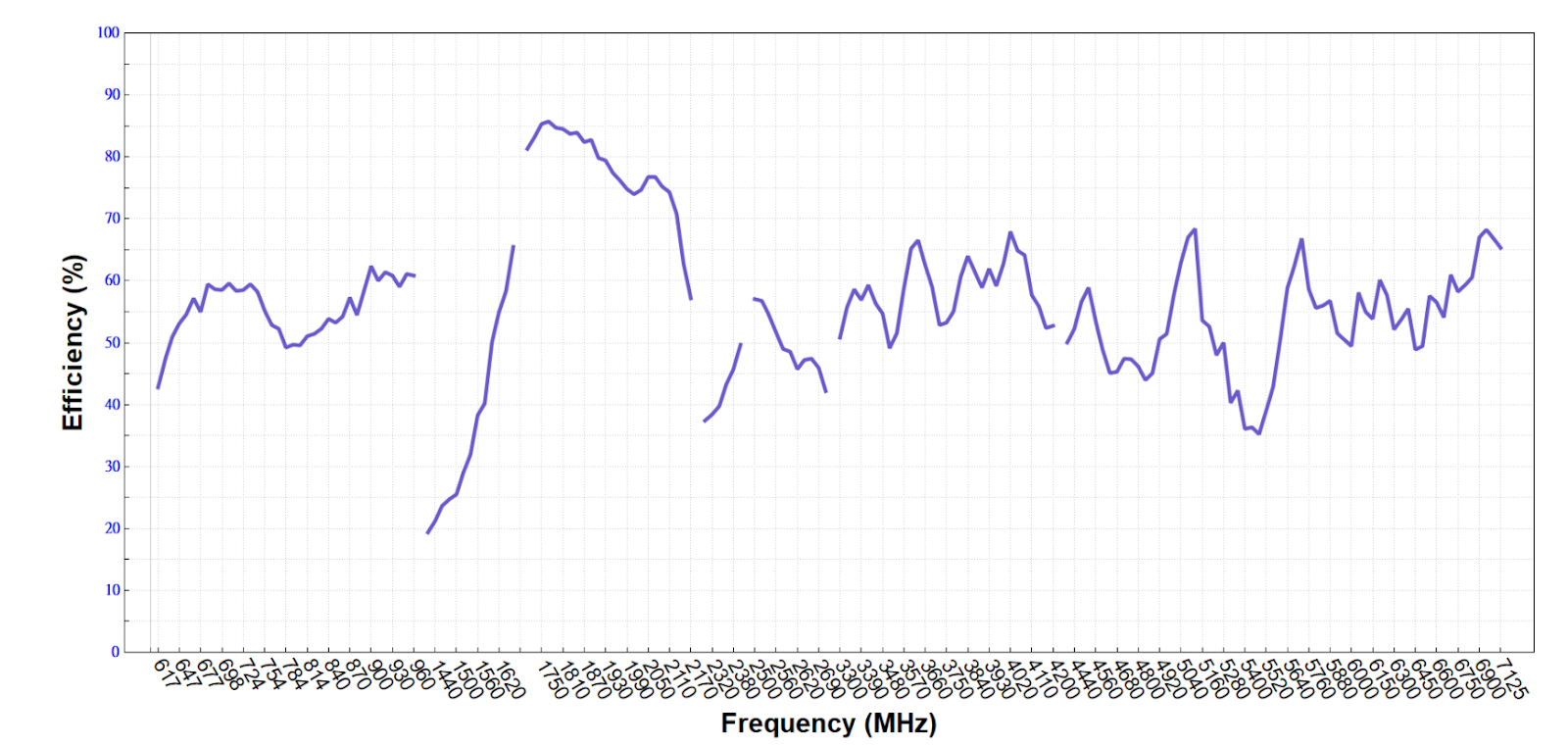
The graph shows the antenna efficiency for both 4G and 5G bands. The cellular bands for Opaca are in MHz: 617-960, 1420-1660, 1710-2170, 2300-2400, 2500-2700, 3300-4200, 4400-7125
The 5G bands covered are:
-
Band 71 (617-698MHz)
-
Band 46 (5150–5925 MHz)
-
Band 47 (5855 – 5925 MHz)
-
Band n79 (4400–5000 MHz)
-
Band n102 (5925–6425 MHz)
-
Band n104 (6425–7125 MHz)
Thank you for reading our article. Antenova offers a host of support materials to add to your knowledge base.
Useful links:
Opaca – SR4L104 Product Detail Page where you will find datasheet, footprint, and 3D model. In addition, you can request a sample and a quote, check distributor availability, and try out the Antenna Placement Tool.
Contact the sales team in your area:
⦁ Antenova AMERICAS - americasales@antenova.com
⦁ Antenova EMEA – emeasales@antenova.com
⦁ Antenova ASIA – asiasales@antenova.com
Additional 5G articles